
Marathon Mixtape
Or, How to Listen to Songs about Running

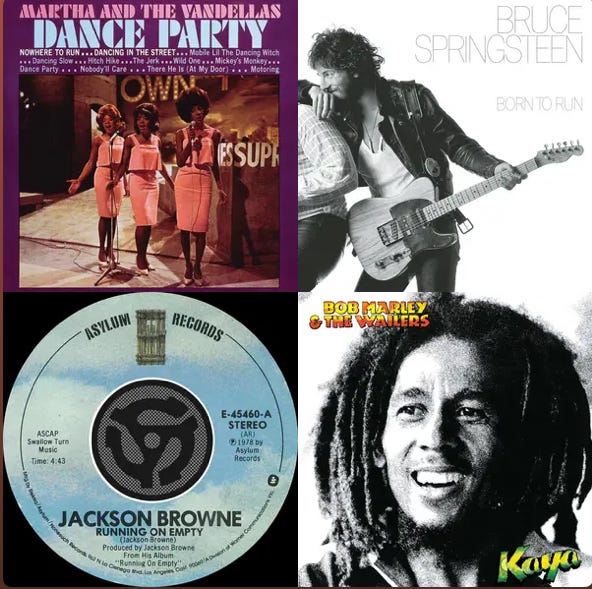
“Nowhere to Run,” Martha and the Vandellas (1964)
I can’t say how old I was when I first saw Robin Williams spin this record in Good Morning, Vietnam, but I must have been sitting in the windowless basement room where, for much of my childhood, we watched TV. Now, whenever it comes on—first drums, then drums and tambourine, then drums and tambourine and horns, and then Martha herself, singing the chorus—I picture soldiers in the jungle, unable to escape the conflict into which they’ve been conscripted.
The song isn’t about the war, however: it’s about an abusive relationship. Even though the singer knows her beloved is no good, she looks in the mirror and sees his face instead. She falls asleep dreading him and wakes up regretting him. Heartbreak is on the horizon, and she can’t outrun her future.
In 1991, four years after we moved into that house on Tanglewood Drive, American soldiers were again invading a foreign country. We watched it live on primetime news as we cut into our pork chops. It made such an impression that in the years that followed I would come to understand, to some degree, the way the singer feels. Never mind what we are running from, there is nowhere to run to. The sofa—brown velvet, if I recall—will have to do.
“Born to Run,” Bruce Springsteen (1975)
The breakout single from Springsteen’s third studio album is often read as a paean to adolescence, the longing to escape from small and stifling towns, and the feeling of freedom that ensues when, even in small ways, you do. But in fact, not everybody is born to run, just those on the margins, the tramps like us who soup up their cars and race down the boulevard. Born to run their hot-rods, but also born to run away from the whole scene—school, work, family, the vagrants they call friends.
Some teacher or parent or scold once called this speaker a tramp, maybe said it of his whole crew, and now, in the song, he’s not even being ironic. From the beginning, he seems to say, the world has consigned us to being beggars, products of our times, our class, our town. Maybe someday he’ll get to a place he actually wants to be, maybe someday he’ll walk in the sun with Wendy by his side. Until then, there’s only this disaffected, directionless need to fill up the time.
For all of its energy and exuberance, all its would-be joie de vivre, it’s an anthem, paradoxically, to running in place. It’s the kind of running that gets you nowhere, and what’s more American than that?
“Running on Empty,” Jackson Browne (1977)
In our early twenties, Susan and I sometimes dog-sat for her parents’ neighbors. They were always flying off to meet new friends in faraway places, which made us suspect that they were swingers. And there was another suspicious thing about them: they loved Jackson Browne. I have never met anyone else who does.
Browne’s most popular track is one of a slew of songs from the 70s and 80s, mostly written by men of our parents’ generation, that look back at the 60s with an almost oppressive nostalgia. Back then, the formula goes, life was just a succession of bright summer days full of freedom and self-actualization. Now, sadly, the years have emptied the singer’s figurative tank. Worse yet, he doesn’t know how he turned onto this road, much less where it leads, or what he’s looking for. He’s running on empty or running behind, running blind or into the sun.
Boo fucking hoo.
The running here isn’t bodily, it’s mechanical. The engine “runs” so the feet don’t have to. At the same time, because it isn’t an actual engine Browne means, the metaphor feels muddled: an engine runs like a body, its pistons pumping like legs, but an engine can run out of fuel (like a body), and in that way the body is like the engine that’s like…the body? What’s really empty here? Where are the fumes coming from?
Those old neighbors eventually split up and moved out, taking their love of Jackson Browne with them. Weird guy, my father-in-law still says of the husband, shaking his head. He doesn’t know what happened to the dogs.
“Running Away,” Bob Marley & the Wailers (1978)
In college I briefly drifted into the orbit of a group of cannabis enthusiasts who listened to reggae religiously. There was much discussion, while high, about the nature of consciousness. Everyone was reaching toward a new understanding, but the only thing I eventually found was a less addled group of friends.
I was in my forties before I could hear the background chord repetitions of a reggae song without recalling the damp towels jammed under the door, the box fans pulling smoke out of dorm room windows, the tapestries pinned to the walls. These days, I’m a little embarrassed by these young men who appropriated Jamaica at the very moment—although I didn’t know this then—that the country was undergoing “structural adjustment” at the hands of the International Monetary Fund.
While there are notable exceptions—Tom Petty’s “Runnin’ Down a Dream” (1989), Bryan Adams’ “Run to You” (1984)—running in pop songs is almost always away (e.g., Iggy Pop’s “Billy is a Runaway” [1979]). That may be because one of our most primal fantasies is the escape for which running is a metaphor. We never tire of this figurative running, which shares little if anything with actual running. It is perhaps easier, and undoubtedly more familiar, to run away than to physically run.
Each of us thinks, at times, that our burdens are the heaviest. But, Marley asks, can you ever run away from yourself? You can try, the song seems to say, but your troubles will follow you. Better, Marley suggests—and here those stoners may have been onto something—to live as though on the housetop. Don’t call it an escape.
“I Ran,” Flock of Seagulls (1982)
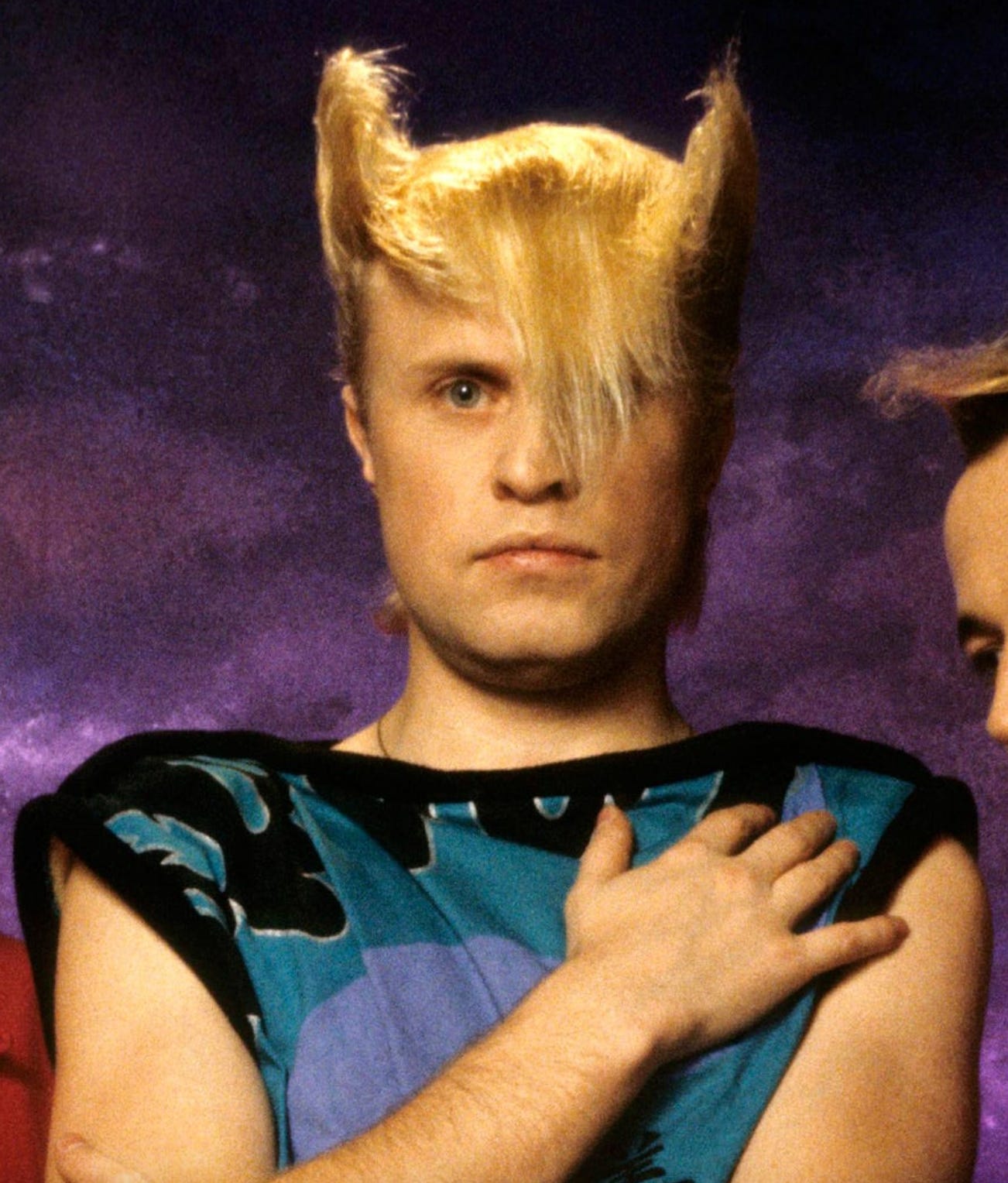
Hard to imagine a less auspicious reaction to the girl of your dreams than running away from her, but that’s the setup for this iconic time capsule of a song, an earworm if ever there was one. The speaker reports a vision: the object of his affection is spot lit by a beam, as from the heavens, and a trippy light show ensues. He reaches out to touch her face, but she’s already disappearing into the light, with which his hand, as he reaches out a second time, seems to merge.
In the low budget music video that accompanied the song’s release, the singer begins by walking through a hall of mirrors, and there is no longer one woman but two, clumsy echoes of the twins from The Shining. He seems bewildered by the whole ordeal, a little agitated even. Girl of his dreams she, or the other one, may be, but he wants only to get away. As the lyrics have it, poor guy, he can’t.
His running isn’t, as in the Marley song, about escaping himself per se. He wants freedom from his desire for her, which, conveniently for him, he believes is all her fault.
You might, for that reason, recognize a much older, possibly balding man beneath the preposterous hair of the twenty-something singer. And in that way, it’s not a time capsule at all: run away from this dude and you’ll run into another. You couldn’t get away from these guys if you tried.
“100 Miles and Runnin’,” N.W.A. (1990)
The year Straight Outta Compton was released, 1988, I was in the fourth grade. As we rode the bus to and from Waukazoo Elementary, some of the other kids listened to the latest tapes on their Walkmans, but I didn’t have the latest tapes, and I didn’t have a Walkman, and frankly I didn’t yet understand this music, which spoke of realities so unlike my own that for my childhood self they might as well have described another country. It was a long time before I realized what it meant that they didn’t.
By 1990 Ice Cube had left the group, and with this, their only E.P., N.W.A. stoked the flames of the feud. But that’s hardly the point of the song, released six months before—at the intersection of Foothill Boulevard and Osborne Street, north of Los Angeles—a twenty-five-year-old man named Rodney King was savagely beaten by four police officers. A year later, and many miles south, riots erupted when the officers were unsurprisingly acquitted.
The song could have only seemed prophetic if you hadn’t been paying attention, if your version of this country had been whitewashed, as mine had. In the music video, as in the song, the rappers are running from the police, but the pursuit is also allegorical. The road they’re running is absurdly long, 100 miles, because it’s not really a road. It’s a way of life.
Still, the beat is up tempo. They’re rapping fast. You could run to this song if you needed to. Like if there was a system you were trying to escape, a home, like Compton, you were trying to return to. Like if you knew that the race wouldn’t end even if and when you made it home. Because the race isn’t a race, and you also didn’t choose it.
“The Distance,” Cake (1996)
I was 17 and a senior in high school the year Cake’s breakthrough single was released, and immediately I was not a fan. They had been taken up, not coincidentally, by a group of popular boys I didn’t like, who soon began dressing in outmoded suits and brimmed hats, as the band does in the video.
At the time, I preferred Pink Floyd’s vision of conformity, and their version of rejecting it. Their song of escape, “Run Like Hell” from 1979’s The Wall, is angsty and angry, which aren’t emotions I can attribute to Cake, except in some sublimated way. Because I didn’t know the word sublimate back then, however, Cake just seemed not to understand itself. If I was projecting, well, I didn’t know that concept yet either.
On the surface, the song is about a race car driver who loses a race and then continues to loop around and around the track. Stupidly, it turns out, because there’s a girl—there always is a Wendy—but rather than going to her he’s pursuing his own doomed ambitions.
In the video, the setting is a corporate office. A man in a tie and suspenders gets down on all fours, as at the starting blocks, before running out of the office, down the street, through a forest, and eventually into the ocean.
It’s pointless, this distance.

“You Are a Runner and I am My Father’s Son,” Wolf Parade (2005)
A friend writes to say this song is the soundtrack to a granularly specific time in her life when she was in her early twenties and living in Austin, Texas. She would listen to Wolf Parade as she drove in the morning dark down Lamar Boulevard to a job she hated. Now, anytime she hears the song she can practically feel the curves in that road.
The singer wears a number, he says, though he is not himself a runner. He is, rather, addressing a runner, the “you” who is the object of his affections. He watches with admiration, knowing that he is his father’s son and so, as the title suggests, incapable of the same kind of endurance. All the singer can do is camp out inside of the runner, emblazoning on his beloved’s heart an image of himself watching the runner running.
Put another way, the runner carries within her the eyes that watch her run. And this recalls, in a way, my friend’s message. Driving down Lamar Boulevard, she had listened without knowing she was making a memory, observing herself as though from outside, and it was this doubleness that she had shared with me. She was both the driver and, at many years’ distance, the woman running along the side of the road, watching her own car pass.
“Dog Days Are Over,” Florence + The Machine (2008)
In my early thirties I needed a beat to get me going, needed the distraction I would later, on most runs, forsake. I listened to songs I downloaded to a small metal square that clipped—how quaint this seems now—onto my shorts or shirt.
When Welch opened her lungs on this rousing anthem, my adrenaline increased, as did my pace. Even if I was not running for my mother or father, my sisters or brothers, it felt good to run fast. I had a lot of longing at that point in my life, and in running I sometimes felt I was leaving it behind. I wasn’t sure, other than the music, what I was carrying with me, but most days I was pretty sure I wanted to survive. I just didn’t know how I was going to.
It seems to be a song about moving forward in your life, about letting go of the people and things that don’t make you happy. It also seems to be about how those things will chase you. Run, Welch commands, and I did. Toward the mountains to the west, then parallel to them, then away, in a four-mile loop.
I lived on a street that fit the soundtrack. It was called Tenacity Drive.
“I Run,” Blu Samu (2017)
Like Springsteen before her, Belgian-Portuguese rapper Salomé Dos Santos, the blue samurai, evokes the underclass in her debut single. The world isn’t safe, her mother warns, unless you have money, and the mother doesn’t, at least not enough to protect her daughter, the teen and ne’er-do-well. It’s the usual line: drop the fantasies, go to school, get a job. You can’t afford to be dumb, or numb—the place you came from, the projects, should have taught that much.
And so, Salomé says, she’s on the run. From that place, from that mother, from the scripts she doesn’t want to follow. She’s chasing her dreams, pouring her soul into the flows she spits. It may be only the harp riff that, for this listener, saves the song from its clichés.
In the video, a young girl steals candy from a shop and charges down the street. A moment later, a grown woman pulls off a wig to reveal, dot dot dot, Salomé Dos Santos. Is this an actual memory transfigured for the song, or is the petty theft metaphorical, a stand-in for precariat dilemmas? Either way, the parallel runs through the video: Samu is both grown and girl, under her mother’s watchful eye and escaping it, the cramped apartment, the housing towers that loom around them.
I’m on the run, the chorus goes, meaning, I suppose, she’s both active and avoidant, keeping busy so as not to be caught up in those other painful clichés to which young people are so often abandoned.
“Run the Road,” Santigold (2018)
It isn’t really a song about running. It’s about the life of a musician, being on the road between one city and another and still another after that. To run the road in this context is like running a gauntlet, passing through dangers and obstacles and temptations. Or else to run the road is to be in charge of the road, as one runs a company.
Running may be mostly metaphorical in pop music, but the listener can also shift that process into reverse, metaphorizing figurative running into the real thing. After all, that’s what most of us do with songs most of the time. Is Future really rapping about a girlfriend in “Purple Reign” (2016) or is girlfriend code for something else? Does it really matter? Will somebody please help the guy already?
What makes a good running song, by which I mean a good song to run to, doesn’t necessarily have anything to do with running. Tempo counts. Mood too. A line like “I believe in the rhythm of the road” doesn’t hurt, even if what I hear in that line as a runner is different from what Santigold meant as a musician. Intention counts for relatively little in the end. The song belongs to the one who hears it.